
Senior community leadership for companies not yet ready to hire one.
How to build community and ecosystem functions that actually move product decisions and lower support costs. For technical companies that treat community as infrastructure.
Less than a quarter of the loaded cost of a senior community hire. Starts next week, not month four.
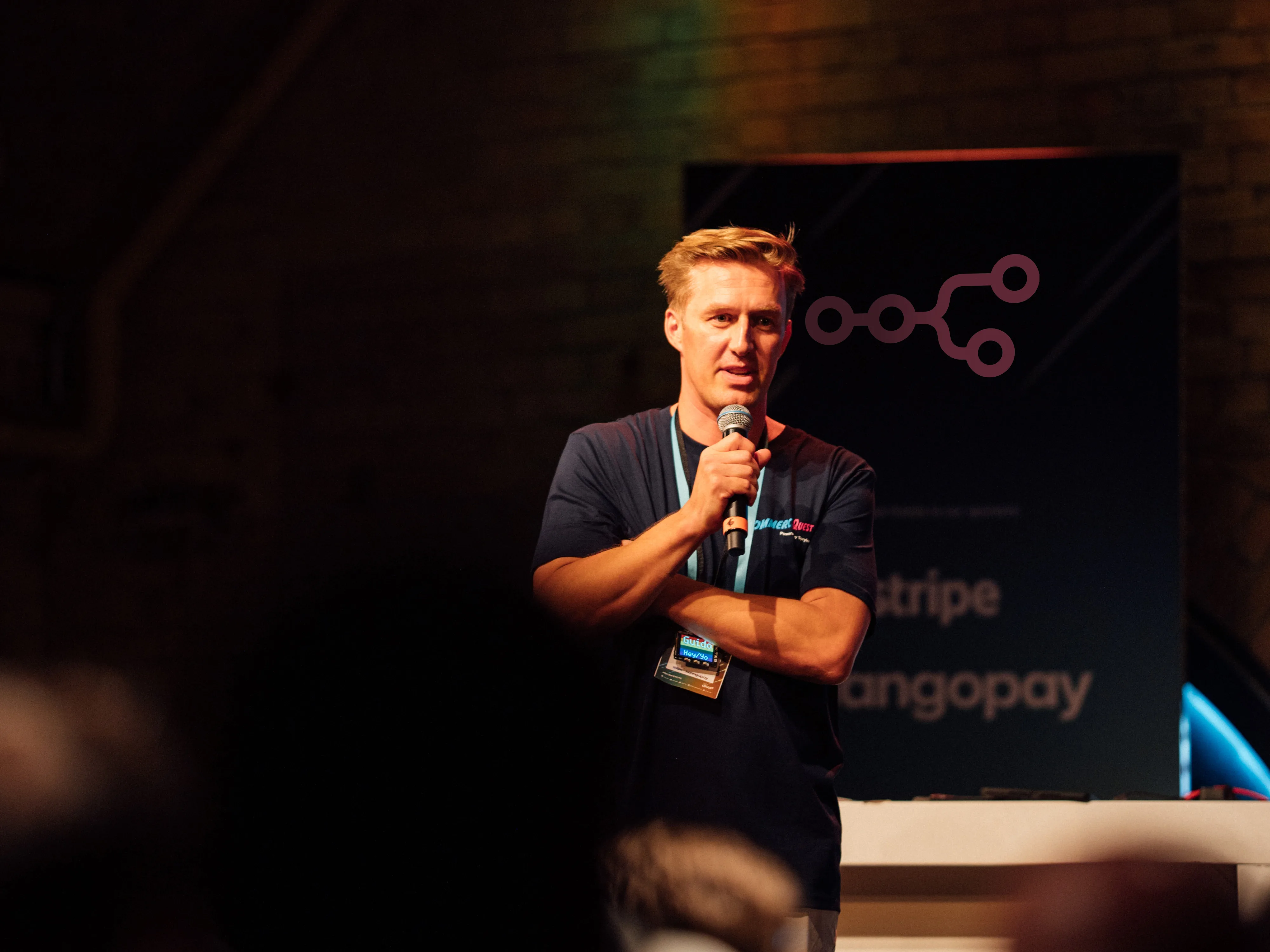
I've built community at Spryker (130+ enterprise clients, with about 25% of product roadmap traceable to community signal), Dutchento / Meet Magento (600+ annual attendees), and CRO.CAFE (200+ episodes across four languages). 207 talks in 28 countries, plus the Community Builder Award from eBay/Magento and the Experimentation Culture Award.
Why this offer exists.
Most Series A–C developer-led companies hit the same wall: a community held together by a junior IC or a founder's spare cycles, with the roadmap drifting in parallel. Four costs compound from there:
- Roadmap drift on community signal. Product decisions stop tracing back to what users are actually asking for. The team can feel it months before the dashboard catches up.
- Junior-IC burnout. The person carrying community gets stretched, makes calls they aren't senior enough to make, and either churns out or stops trying. The function rebuilds from zero.
- Budget-review carnage. Community is the first line cut when nobody can defend it with numbers. You spend a year rebuilding what got knifed in one finance meeting.
- The €200K wrong-hire. Senior community hires without a tested thesis are a year lost and a re-recruit. The retainer tests the thesis before the hire.
Two ways to use it: as a bridge to a senior hire, or as ongoing senior leverage if you don't plan to make one.
Senior thinking partner. So your team gets to actually execute.
You're probably one of three people: a founder figuring this out alongside the roadmap, a junior IC carrying community as 30% of the job, or a senior leader who's done it before but is stretched across four other priorities. The retainer fits all three.
I work as a senior thinking partner for whoever is currently doing the work, covering the patterns they haven't seen yet (what to invest in, what to stop, what to ignore).
In practice: the person already doing this work has senior backup. Decisions move faster, and the roadmap stops drifting off community signal.
The alternative
Senior community / DevRel hire
- Loaded cost
- €150K+ per year
- Time to start
- 3–4 months to land
- Wrong-hire risk
- High. No scorecard yet to hire well.
- At month 6
- Maybe an onboarded leader.
The retainer
Six-month advisory
- Loaded cost
- Less than a quarter of the hire.
- Time to start
- Next week.
- Wrong-hire risk
- Tested before the hire.
- At month 6
- A scorecard, a working system, and the decisions already made. Whether or not a senior hire ends up making sense.
What's different at month six.
Six months in, the way community work happens has shifted. Here's what's different:
- Senior community attention lives on the calendar. Questions that used to sit open for weeks get closed in the next call.
- Wasted community spend has been cut. What wasn't producing was killed in week one; what was producing got doubled down on.
- The person currently holding community has senior backup. Decisions move faster, and harder calls don't sit open for weeks.
- Roadmap drift on community signal has stopped. There's a defined process, running on cadence, defensible at budget review.
- A hiring scorecard exists for when you're ready. A wrong senior community hire is a €200K mistake. The scorecard reduces that risk.
And the documents you walk away with:
- A community and ecosystem architecture: who your community is for, how participation is designed, and where signal flows back into the business. Yours to keep, evolve, and hand to a new hire.
- A hiring scorecard for community / DevRel / ecosystem roles, calibrated to your stage and product. Useful at month six and again at year two.
- A signal-to-roadmap process: the actual mechanism that translates community input into product, sales, and strategic decisions. Lightweight enough that someone will actually run it.
- A measurement framework: what to track, what to ignore, and what would falsify your community thesis. Borrowed from the CRO and experimentation playbook.
Three pillars: Psychology, Pattern, Proof.
Psychology
Built for how technical users actually behave.
Most community work is designed for the community manager's idea of community, which usually has very little to do with how developers actually behave in the wild. My cognitive psychology background mostly taught me one thing: you can't reliably predict what people will do. So everything I recommend is built to be tested: who stays, who contributes, what flips a lurker into a contributor. You find that out by running the thing, not by guessing.
Pattern
Three zero-to-community builds, retooled for the AI era.
Three very different contexts (Spryker, Dutchento, CRO.CAFE), same underlying pattern, retooled for an era when half the lurkers are agents and bot signal looks like human signal until it doesn't. The advisory is the shortcut: what still works, what's quietly broken, and which AI-flavored plays look exciting but waste a quarter.
Proof
Community work that survives the budget review.
Community work that can't be tied to business outcomes is the first thing cut at budget review. I came up through CRO and experimentation, so what we build together is set up to be measured. At Spryker, about 25% of product roadmap decisions traced back to community signal. That's what makes community a real line item: defensible at every budget review, not a soft cost-center waiting to get cut.

About the advisor.
Guido X Jansen. 21 years building communities, most recently the enterprise community function at Spryker (130+ enterprise clients, about 25% of product roadmap traceable to community signal). Cognitive psychology and CRO background, which mostly taught me you can't reliably predict what people will do, so I design community work as small experiments and watch what they actually do with them.
Brands I've worked with
From retail to telecom to financial services, I've helped teams across industries build stronger communities.















Past colleagues and clients on the work.
Quotes from work pre-advisory. Advisory references on request after the scoping call.
“Guido is a thought leader in community building and developer relations. Any company serious about building an ecosystem should talk to him.”

Boris Lokschin
Co-Founder & CEO, Spryker
“He delivered results that mattered: developer feedback shaped our product roadmap, engineering teams connected directly with external developers.”

Chris Rauch
Chief Customer Officer, Supermetrics
“Guido doesn't just build communities, he architects ecosystems that thrive under change and constant evolution.”

Svitlana Kulynych
Senior Manager for L&D Business Engagement, PwC Luxembourg
A structured six months. Rolling thereafter.
Phase 1 · Inside the first six months
-
Week 1: Onboarding and ecosystem baseline
A 90–120 minute kickoff call, plus a written baseline of where your community stands, what's worth building first, and what to stop spending on. The point of week one is to make sure none of your investment gets wasted on the wrong direction.
-
Recurring cadence
Every two weeks: a standing strategy call
Twelve sessions of sixty minutes each, across the first six months. The one place on the calendar where community strategy gets senior attention without fighting for it against everything else on your team's plate.
-
Recurring cadence
Every month: a one-page written brief
The next things to act on, the things to stop, and what to keep an eye on. Written so it can be forwarded to your CEO or board without translation.
-
Month 3: mid-engagement review
A hard mid-point audit. Are we still building the right thing, given what we've learned and what changed in your business? We re-baseline if needed. If the review surfaces a fundamental mismatch, either side can exit clean: refund of the most recent month, all artifacts delivered through the cutoff.
-
Month 6: synthesis and decision point
The artifacts from the previous sections, finalized. Decision point: continue rolling, pause, or close. Either way, you walk away with documents your team keeps using long after I'm out of the calendar.
Phase 2 · Beyond six months, if it's working
-
Beyond month 6: rolling cadence
Same rhythm, no fixed end. Calls, monthly briefs, async channel: nothing changes about the cadence. Either side gives thirty days' notice when the engagement no longer fits.
Throughout · the whole engagement
A dedicated async channel
Slack, Signal, or whichever tool you already use. For the questions that come up between calls and shouldn't wait two weeks.
Who this works for, who it doesn't.
In scope
- Community / DevRel / ecosystem strategy
- Community ops design: governance, contribution structures, advisory boards
- DevRel function design and metrics
- Translating community signal to product roadmap
- Hiring input for community / DevRel / ecosystem roles
- Coaching the existing person currently holding this responsibility (often a junior IC, or someone wearing it as 30% of their job)
Out of scope
- Implementation or hands-on community management
- Content production for your community
- Hands-on engineering, SDK work, or demo coding
- Pure marketing or social media management
- Sales-quota carrying responsibilities
Good fit
- Series A–C company, technical or developer-led product
- Has product traction but no senior community/ecosystem hire yet, or has a junior person in role who needs guidance
- Leadership treats community as strategic, not as a megaphone
- Organisation can act on architectural and design recommendations
Not a fit
- Need someone to run community ops. This is advisory, not fractional execution.
- Want guaranteed traffic, signups, or community-size growth
- AI-content-at-scale community plays
- Looking primarily for social media marketing rather than community strategy
- Adtech, gambling, fossil fuel, or Russian-owned companies
- Also: advisory and public platform stay strictly separate. Paying clients don't get conference referrals, intros, or public recommendations. If you're buying influence, this isn't the offer.
Questions worth answering before you apply.
If yours isn't here, the 30-minute scoping call is the right place for it.
How many open seats?
Five concurrent at most. Waitlist when full. One company per competitive space, the rest queue.
How does this fit alongside your other work?
Advisory, speaking, and selective full-time leadership conversations are separate tracks. The advisory engagement has a defined six-month minimum scope, with the written commitments below covering what happens if anything changes mid-engagement.
How long can the engagement run?
The first six months are a fixed commitment, long enough to cover the Week 1 baseline, the Month 3 review, and the Month 6 synthesis. After that the engagement runs month-to-month with thirty days' notice from either side. No forced renewal conversation, no cliff.
What if the engagement isn't delivering value?
A re-baseline conversation at month three is built in. Beyond that, thirty days' notice from either side. The notice period is prorated, and all artifacts get delivered up to the cutoff date.
What if the month 3 review says it's not working?
Either side can call it at month three. We deliver every artifact through the cutoff date, and the most recent monthly fee is refunded. No extended notice, no fighting. Month three is when we find out. That's the point of having a hard mid-point review.
What happens if you take an in-house role mid-engagement?
The engagement continues through its committed period. Senior roles take 3–4 months to start, so in practice nothing changes. In the rare case it can't continue, every open artifact gets delivered through the cutoff, and I personally introduce you to a vetted advisor from my network. No engagement gets left mid-air.
Is the engagement confidential?
Yes. Company name, strategy, and the existence of the engagement aren't disclosed unless you specifically want them to be.
Can we do weekly calls instead?
The default cadence is one call every two weeks. During specific intensive windows like migrations, launches, or hiring sprints, we can switch to weekly. No additional fee.
Can we talk to a past advisee?
Yes. References on request after the scoping call.
What if our community lead quits in month three?
The advisory continues. Hiring the replacement is a conversation we have together, using the hiring scorecard built during the engagement.
Do you do implementation?
No. The advisory works on the design and the decisions; your team or contractors run the execution. It keeps the offer clean and avoids the conflict of interest where I'd be advising on work I also bill to deliver.
What if our IC is too junior to operationalize the advice?
Common situation. The retainer is designed for it. Inside the first 30 days, the IC gets a written prioritization of what to start, stop, and ignore, plus a measurement framework that makes their work defensible at the next budget review. What doesn't change: the IC is still the one doing the work. The retainer is senior backup on the decisions, not on the execution. If the IC can't run the advised plays at all, the month 3 review surfaces it early and either side can exit clean.
Two ways in.
3 of 5 seats open · Next intake closes 31 October · Application or 30-min scoping call.
Less than a quarter of the loaded cost of a senior community hire. Starts next week, not month four.
Pick the path that fits. The pricing range is shared by email after the first contact, regardless of outcome.
A: 30-minute scoping call
Best if you're not yet sure whether the engagement fits. We talk for thirty minutes. You leave with the pricing range, a fit assessment, and either an application invite or a referral elsewhere.
Tell me up front: company name, your role, one sentence on what you're trying to figure out, and one sentence on your current community / ecosystem state.
B: Direct application
Best if you already know you want this. Email the items below. Response within five business days: acceptance, decline with a brief reason, or a scoping invite. Pricing range comes back in the response either way.
- Name + work email
- Company + your role
- Company website
- Stage (Series, ARR range, or "pre-revenue")
- Current community / ecosystem state, in one sentence
- Optional: Six-month outcome you'd want
- Optional: Desired start date
Looking to book me for a conference or event instead? Speaker information →