

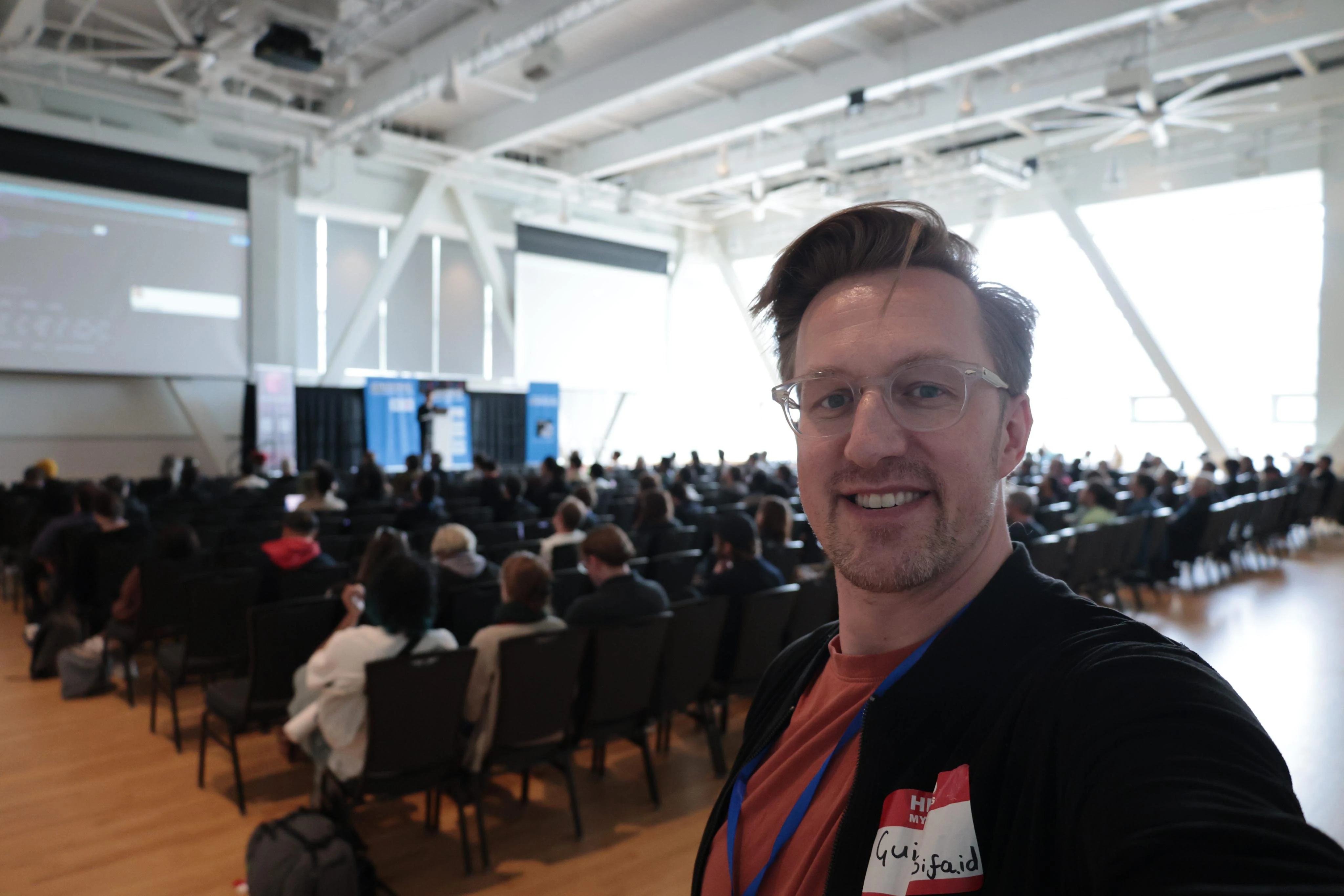
Last week I flew to Vancouver for ATmosphere Conf, the second edition of the worldwide AT Protocol community conference. Four days. 370 people on-site, around 500 more online. All working on one question: what does the internet look like when it’s built for people, not platforms?
The energy was the highlight
The biggest thing for me wasn’t a specific talk or launch. It was the energy in the rooms and in hallway conversations. Genuinely optimistic about the future of the internet in a way I haven’t felt in the open source/tech world in probably 10+ years. People were excited and actually collaborating, not just networking.
The participant mix was interesting too. Older folks (like me) who remember the openness and promises of the early internet in the 90s, alongside a younger generation that’s fed up with Big Tech treating them as data to monetize instead of people to serve. Both groups showing up for the same reason, and it clicked immediately.
Talk highlights
Toni Schneider’s first public speech as Bluesky’s new CEO. He laid out an ambition that resonated with the whole room: Bluesky should not be a big app on a small AT Protocol pie, but a small app on a much bigger AT Protocol pie. That matters, coming from the company that is the protocol’s largest player by far. (He also registered and completed his Sifa profile, which I appreciated.)
Erin Kissane opened the main conference day with “Landslide”, a keynote about what’s happening to our ability to collectively know things. She used kelp and holdfasts as a metaphor — the parts that anchor the whole organism to rock while everything around it gets battered by waves. That’s what our information infrastructure needs, and we don’t have it right now. As she put it afterwards on Bluesky: “Felt wild to be able to be that honest.” She also wrote up her notes if you want the full version.
Amber Case’s “Waiting for the Future to Load” was one of those talks that pulls you in deeper with every minute. A cyborg anthropologist’s take on why our visions of the future are stuck in the past: people building tech are either trying to recreate their childhood or trying to make money. She connected the Wizard of Oz to Norbert Wiener’s cybernetics to automotive history, and somehow landed on “design is governance” in a way that actually made sense. People on Bluesky were calling it one of the best talks at the conference, and I’d agree.
Jay Graber and Paul Frazee launched Attie, an AI assistant that lets you build your own algorithms and custom feeds on Bluesky. You can even change the Bluesky interface if you want to (for example, hide handles). The key line from Jay: “AI should serve people, not platforms.”
Daniel Holmgren walked through the protocol’s dependencies on Bluesky and what the community should be doing to become truly independent. He got into the specifics: which parts of the infrastructure still rely on Bluesky, what the alternatives are, and what’s missing. I don’t think I’ve ever been at a conference where a commercial company’s head of protocol told everyone exactly how to not depend on them.
Alex Komoroske and Mike Masnick did a fireside chat on Resonant Computing, a manifesto for software that adapts to you instead of optimizing for engagement metrics. Five principles: private, dedicated, plural, adaptable, prosocial. They sound obvious until you realize almost nothing we use today meets them.
Dietrich Ayala summed up the ecosystem’s fragility in a post during the conference:
the ecosystem is delicate. there’s a LOT of enthusiasm + talent, but: no magical investor monies, grant options are THIN, many first time founders, many don’t want investment, few other options, scary macro env. it’s a collective challenge. we can just pay for things?
Why that last point matters to me
I’m now building on the AT Protocol too:
Barazo is a federated forum (think Discourse, but your members’ data lives on their own Personal Data Server and their identity is portable across apps). I wrote more about the architecture and motivation in a previous post.
Sifa (already at 250 users) is a professional network where your reputation comes from actual community contributions, not self-reported endorsements. And without the performative stuff we see on LinkedIn.
The sustainability question Dietrich raised applies directly. These are open source tools for communities, not VC-backed growth plays. They need real business models.
IETF makes it official
The IETF just approved a formal AT Protocol working group to turn this into a proper internet standard. That gives the protocol a path to the same kind of legitimacy that HTTP and email have, not dependent on any single company’s goodwill.
Thanks to the organizers
Big thanks to Boris Mann, Ted Han, Chad Kohalyk, and all the volunteers who made this happen. 370 people, four days, and everything ran smoothly.
Back to the backlog
So now I’m home, and my backlog of ideas and community integrations got considerably longer. That’s the best kind of conference outcome.